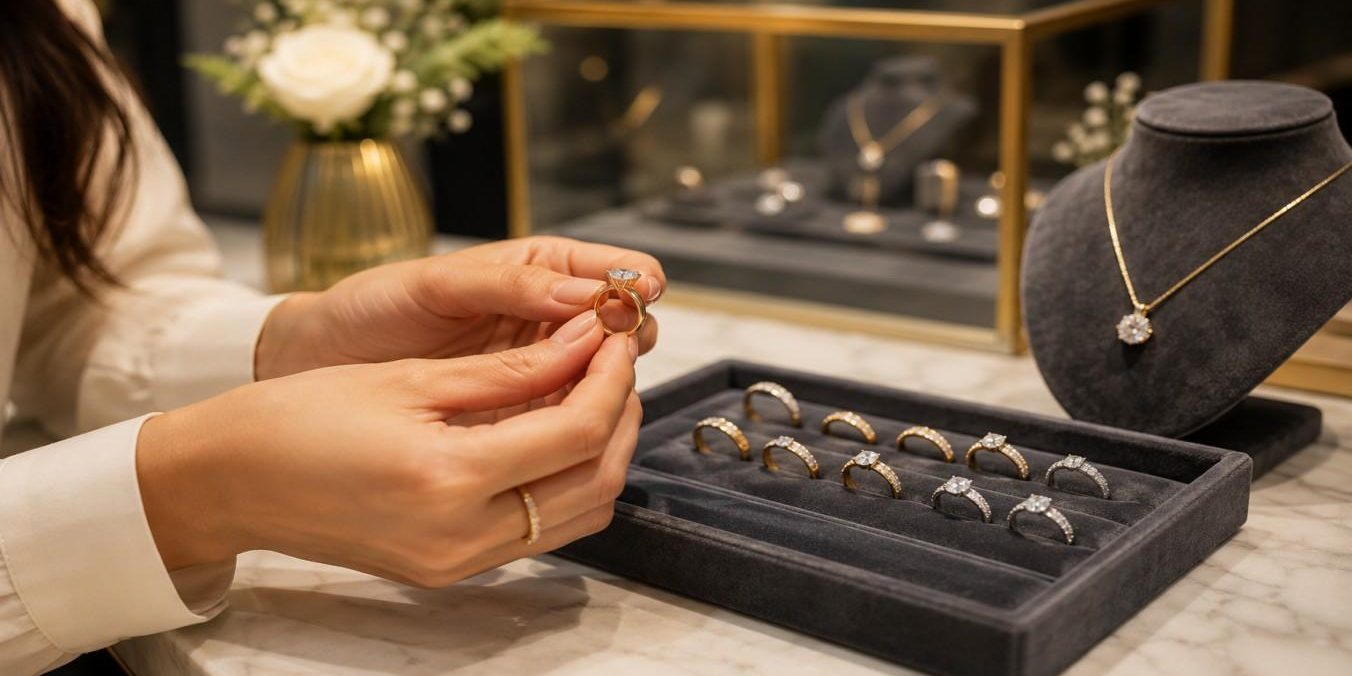
Buying fine jewellery is one of the most personal investments a person can make. Whether you are searching for an engagement ring, a custom gift, or a piece to treasure for generations, knowing what to look for changes everything. At Ordekian Jewellery on the Gold Coast, we believe every buyer deserves clear, honest guidance before they commit.
Key Takeaways
- Understand the metal before you buy: Gold purity (carat), silver standards, and platinum grades all affect value, durability, and appearance.
- The 4Cs determine diamond quality: Cut, Colour, Clarity, and Carat together define how a diamond looks and what it is worth.
- Always ask for certification: GIA-certified stones provide independent verification of quality and protect your investment.
- Know your consumer rights in Australia: Under Australian Consumer Law, jewellery must match the descriptions provided by the seller.
- Custom jewellery offers genuine value: A bespoke piece crafted for your budget and brief often outperforms off-the-shelf options in quality and meaning.
1. Understanding Precious Metals
The first decision in any jewellery purchase is the metal. Not all gold is equal, and the difference between a 9ct and an 18ct piece is significant in terms of purity, durability, and appearance.
Gold purity is measured in carats:
- 24ct gold is 99.9% pure. It is the richest in colour but too soft for most jewellery applications.
- 18ct gold is 75% pure gold. It offers the ideal balance of richness, durability, and warmth. At Ordekian Jewellery, this is our preferred standard for fine pieces.
- 14ct gold is 58.5% pure. More affordable, with slightly less lustre, it is well-suited to everyday wear pieces.
- 9ct gold is 37.5% pure. The most durable and budget-friendly option, though with a paler tone.
As the Jewellers Association of Australia guide to precious metals confirms, any alloy that does not meet the required purity percentage does not comply with Australian Standard AS2140-2008 and may breach Australian Consumer Law. This is why buying from a reputable jeweller with transparent documentation matters.
Silver and platinum:
- Sterling silver is 92.5% pure and should carry the hallmark 925.
- Platinum is hypoallergenic and exceptionally durable. It is commonly marked PT950 (95% pure) or PT900.
2. Understanding the 4Cs for Diamonds
If your jewellery purchase involves a diamond, familiarity with the 4Cs is essential. These four attributes (Cut, Colour, Clarity, and Carat) are the internationally recognised standard for evaluating diamond quality, and every reputable jeweller should be able to discuss them clearly with you.
- Cut: Cut is the most important of the four Cs. It determines how the diamond interacts with light. A well-cut diamond reflects light back through its crown with maximum brilliance. A poorly cut stone, regardless of its colour or clarity grade, will appear dull. When comparing stones, always prioritise cut quality first.
- Colour:Diamond colour is graded from D (completely colourless) to Z (visibly tinted yellow or brown). For most buyers, a grade between G and I provides excellent visual whiteness at a more accessible price point than the D to F range. The difference between D and G is largely imperceptible to the naked eye once a stone is set.
- Clarity: Clarity refers to the presence of internal characteristics (inclusions) or surface blemishes. Most inclusions are invisible without magnification. A VS2 or SI1 clarity grade offers an eye-clean stone in most cases, providing excellent value without compromising visible quality.
- Carat: Carat measures the weight of the diamond, not its size. A well-cut diamond can appear larger than a heavier stone with a poor cut, because it distributes its dimensions across the surface rather than into depth. Working with carat alongside cut gives you a clearer picture of apparent size and value.
3. Certification: Why It Matters
A diamond without a grading certificate is a diamond without independent verification. No matter how confident or persuasive a jeweller may be, the only objective confirmation of a diamond’s quality comes from a recognised gemological laboratory.
The Gemological Institute of America (GIA) is the global standard for diamond grading. A GIA Diamond Grading Report documents the stone’s 4Cs, confirms whether it is natural or laboratory-grown, and discloses any treatments or alterations. A GIA report ensures consistent, reliable grading and provides essential documentation for insurance and future resale. At Ordekian Jewellery, all diamonds above 0.30ct are GIA-certified as standard.
What to check on any certificate:
- Confirm the certificate number matches the laser inscription on the stone.
- Check the grading laboratory name. GIA and IGI are the most widely recognised and trusted.
- Review the full 4Cs grading and any noted treatments.
- Retain the certificate with your purchase documentation for insurance purposes.
4. Ethical Sourcing: What to Ask
For many Australians, where a diamond or gemstone comes from is as important as how it looks. Conflict-free sourcing has become a baseline expectation, and responsible jewellers are transparent about their supply chains.
A 2025 ethical jewellery study cited in the overview of top Australian jewellery brands and ethical sourcing practices in 2025, revealed that over 60 per cent of Australian consumers are now actively seeking ethically and sustainably produced jewellery. This is no longer a niche preference. It is a mainstream expectation that reputable jewellers are happy to address directly.
Key questions to ask your jeweller:
- Are your diamonds conflict-free and compliant with the Kimberley Process?
- Is the gold responsibly sourced or recycled?
- Do you hold or are your suppliers covered by Responsible Jewellery Council (RJC) certification?
5. Your Consumer Rights Under Australian Law
Buying jewellery in Australia comes with legal protections that many buyers are not aware of. Under the Australian Consumer Law (ACL), businesses are prohibited from making false or misleading representations about their products. This applies directly to metal purity, gemstone descriptions, and product quality claims.
As the ACCC guidance on jewellery industry fair trading and gemstone descriptions makes clear, jewellers must accurately disclose whether gemstones have been treated, and must use the terms natural, laboratory-made, synthetic, and created correctly. If a jeweller cannot provide documentation to support their claims about a piece, that is a significant warning sign.
Your rights include:
- Receiving a product that matches all descriptions provided at point of sale.
- Disclosure of any treatments that have altered a gemstone’s natural colour or clarity.
- A remedy (repair, replacement, or refund) if a product does not meet its stated specifications.
6. Custom Jewellery: A Smarter Way to Buy
Custom jewellery is not just for those with unlimited budgets. In fact, for most buyers, a bespoke piece made to brief can offer better quality, better fit, and better value than a comparable off-the-shelf option from a large retailer.
When you commission a custom piece, you control the metal, the stone, the setting, and the design. Every dollar goes into the piece itself rather than into retail overheads, brand premiums, or inventory costs. Our custom made jewellery service at Ordekian allows you to bring any vision to life, from a sketch or reference image through to a finished piece handcrafted in our Gold Coast workshop.
For buyers considering an engagement ring specifically, guidance on engagement ring budgeting and the 4Cs for Australian buyers walks through how to allocate a budget across the key quality factors to achieve the best outcome for your investment.
7. Jewellery Care and Valuation
A fine piece of jewellery requires ongoing care to maintain its condition and value. Beyond regular professional cleaning, an independent valuation is important for insurance purposes and to track the current replacement value of your piece.
Practical care guidelines:
- Have your jewellery professionally inspected and cleaned at least once a year.
- Check prongs, clasps, and settings regularly for looseness or wear.
- Store fine pieces individually in soft pouches or padded compartments to prevent scratching.
- Remove jewellery before swimming, exercise, or exposure to chemicals including household cleaners.
- Commission an updated valuation every two to three years, particularly for diamond pieces, as replacement values change with the market.
Conclusion
Whether you are purchasing your first piece of fine jewellery or commissioning a once-in-a-lifetime custom design, the right guidance makes all the difference. Our master jeweller Mihran Ordkian is available for a free consultation at our Gold Coast studio. Contact us today to begin.
FAQs
What should I look for when buying jewellery in Australia?
Check metal purity markings (hallmarks), ask for GIA certification on diamonds, and confirm the jeweller’s reputation and consumer rights policies.
What is the best gold carat for everyday jewellery?
18ct gold offers the best balance of purity, durability, and warmth for most everyday and fine jewellery purposes in Australia.
Do I need a GIA certificate when buying a diamond?
Yes, always request a GIA certificate. It provides independent verification of the diamond’s quality and protects your investment.
What are the 4Cs of a diamond?
Cut, Colour, Clarity, and Carat Weight. Cut is the most important, as it determines the diamond’s brilliance and overall visual impact.
What consumer rights do I have when buying jewellery in Australia?
Under Australian Consumer Law, jewellery must match its description, and gemstone treatments must be disclosed. You are entitled to a remedy if it does not.
Is custom jewellery more expensive than buying from a retail store?
Not necessarily. Custom pieces eliminate retail mark-ups and are priced based on your chosen materials, often delivering better value at equivalent quality.